On May 5th of 2025 I began my position as a Water Research Technician at the Canada Centre for Inland Waters in Burlington, Ontario. The co-op job search for the summer semester of ’25 was arduous and full of disappointment on a number of fronts. Not only is summer the most competitive time for environmental science students trying to find seasonal contracts, but many budget cuts have hit the sector hard – especially in ECCC where most uGuelph students get hired. I think I applied to a little over 20 positions with only a handful of interviews, and even less job offers which was really disheartening as I believe I have a pretty good resume and interviewing skills. I tried not to take it too personally.
It was sometime in early March in the stuffy changeroom of the Guelph Country Club after our late 9:30pm ball hockey game when I got the email.
“Stef!” I said in astonishment. The interview had been over a month ago, and I had pretty much given up on hearing back.
“What?!” She called back, thinking I had received some horrendous news. She had become something of my ball hockey mom, or my beer buddy, whichever you prefer.
“I just got a job!” I paused as I read the email over again, “And they’re offering an 8-month contract!”
Stef came over as I showed her the email, “God, Val, I thought something awful had happened. Don’t shout like that!”
“No, you don’t get it. This means I can play hockey for the spring and summer. Do you think Erica has left?” Erica is our team captain, and that day was the last possible day for me to sign up for our spring season league to which I had to let her know with my employment situation, I’d have no idea where’d I’d be.
“Maybe. Run, Val, Run!”
As I ran out of the building and into the chilly late winter, not yet spring, air, I realized Erica had in fact left for the night. Me and Stef were usually the last ones out anyway, so I quickly texted our team group chat with great enthusiasm. I could stay!
I wish I could say I retained that excitement through the entirety of my work term; I wanted the job quite badly as it entailed working on research vessels and seemed like quite a good mix of field and laboratory work. Well, that’s what it said on paper anyway. Remember how I said ECCC was getting hit the hardest with budget cuts? You can read all about the ‘Departmental Plan: 3-year Budgeting Initiative’ here that outlines just how much the higher ups- actually I shouldn’t say that. I still want to be hired there in the future, that is, if they ever have the funds to hire.
I think my summer term co-op report explains my dissatisfaction with the situation the best, so I will copy the section on ‘Budget Cuts and the Workplace’ below:
ECCC has created and begun to implement a 3-year long budgeting initiative that has resulted in direct cuts to research team funding. These cuts have already impacted the amount of summer students groups are able to hire – our lab usually hiring 2 summer students instead of just 1 (me), and the ability for many research teams to conduct any field work at all.
During my interview, and in the job posting, it was very clear this position was to be primarily fieldwork for the summer months followed by progressively more lab work as the weather became colder. Field sites included Hamilton Harbour, Cobourg ON, Humber Bay ON, Lake of the Woods ON, as well as the possibility of Lake Winnipegosis MB. All but our mandatory weekly sampling of the Harbour were completely slashed leaving everyone with a severe lack of things to do. I have always known I am the type to have to be ‘doing’ in order to feel secure and comfortable, or else I feel antsy and unfulfilled. Unfortunately, with even further cuts affecting the time I was able to receive small vessel safety training, I wasn’t allowed in the field at all until late into August, confining me to the lab to process previous years samples. The lack of fieldwork is incredibly dissatisfying, and the general atmosphere of the CCIW is very glum as many research teams are effectively useless until more funding is provided. Many are also anxious that lay-offs may be on the horizon for indeterminate staff.
Without a balance of fieldwork to the repetitive tasks of laboratory work, and general workplace atmosphere, I found it very challenging to stay motivated. I would often finish my work for the week within a few days with little to no additional work for my supervisor to provide me.
It’s by no fault of my supervisors or my employer that this has occurred. No one saw it coming. But that doesn’t mean I can’t be upset about it. It’s kind of depressing, so I will move on and talk about some of the cool things I managed to do and learn during my 8-month stint working on Hamilton Harbour.
Bug Patties
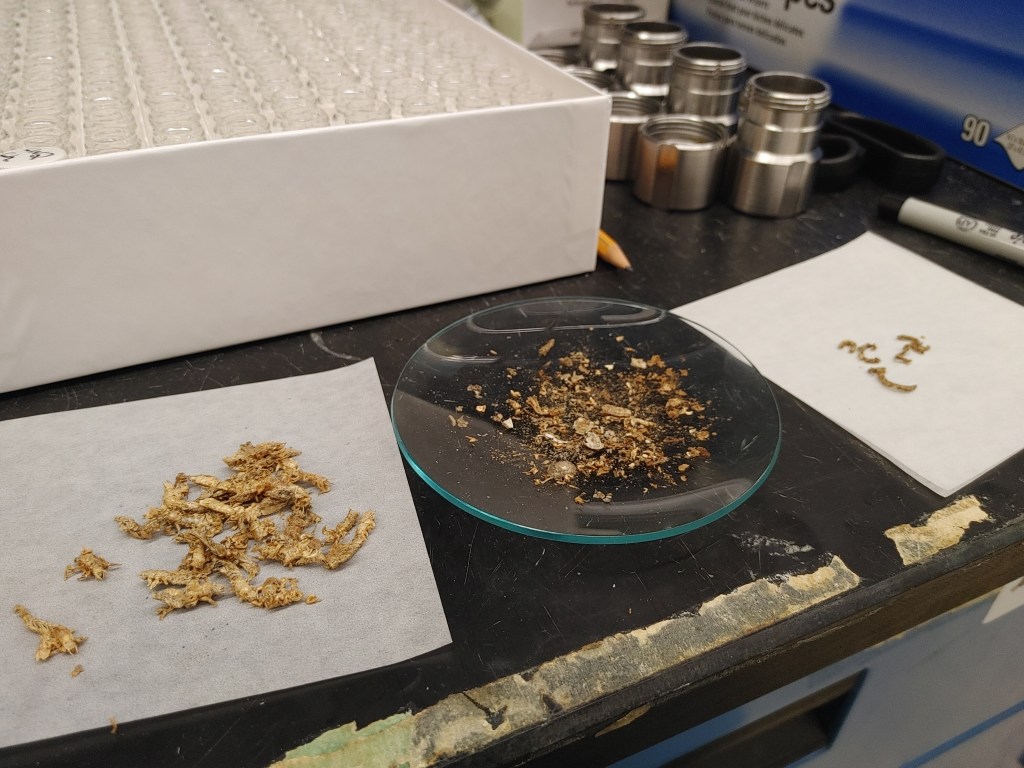
One of my first tasks as I slowly was confined to my fate of lab work until late summer was dissecting freeze dried clumps of freshwater lake invertebrates (lake bugs). I’d do my best to separate specimens into piles of their species – the hexagenia (mayfly larvae) were often in bits and pieces so now I am really good at knowing what their legs and beaks and other parts look like by themselves, and then weight out specific amount of them to be packaged into tin capsules, or ground into dust depending on how much of them were present in each patty. Eventually, the specimens will get shipped out to Saskatchewan to be analyzed on an isotopic level to see what isotopes of carbon and other elements are present. Often, the health of a lake can be directly studied by the composition of the organisms within it as bioindicators.
I’d spend most of my days hunched over a lab bench and learning to enjoy the smell of crusty lake bugs while I looked at amputated legs of hexagenia and abdominal seta of chironomids from Lake Winnipeg. I listened to A LOT of podcasts and music during this time and would go days without seeing any of my coworkers pretty much.
Filtering
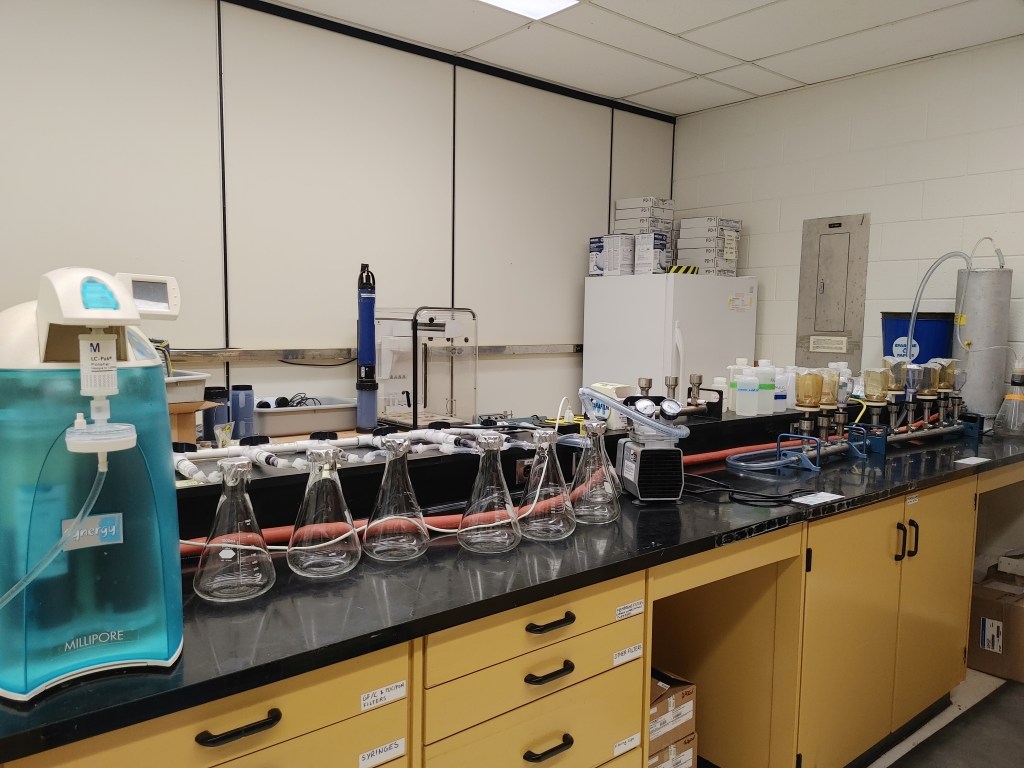
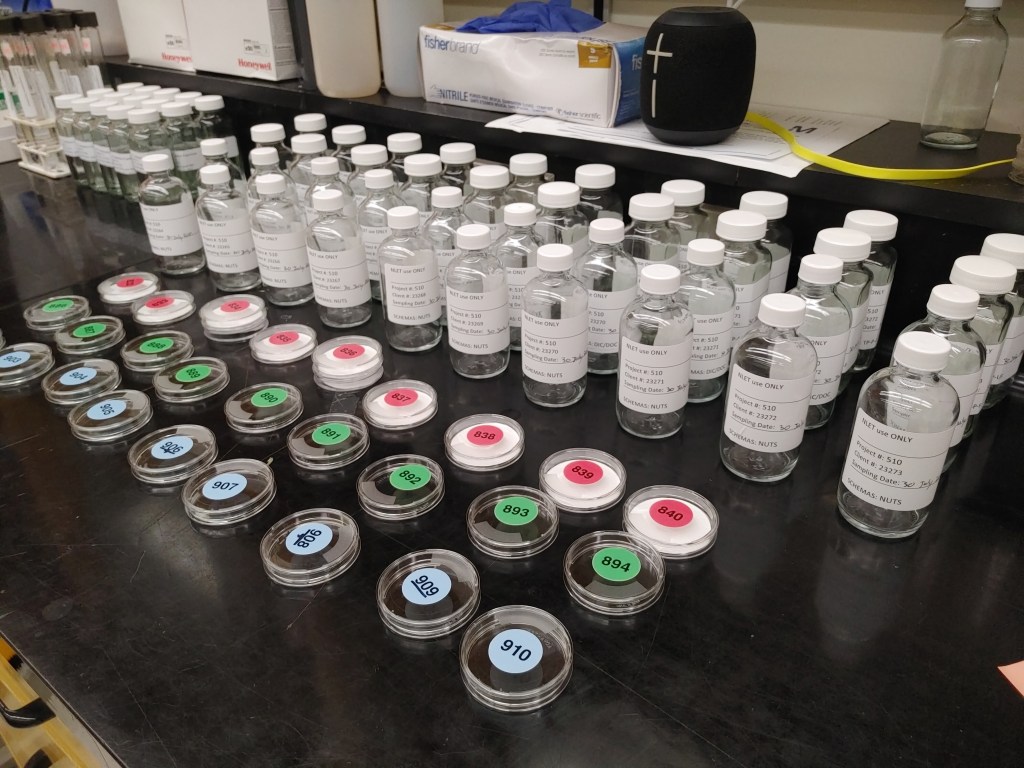
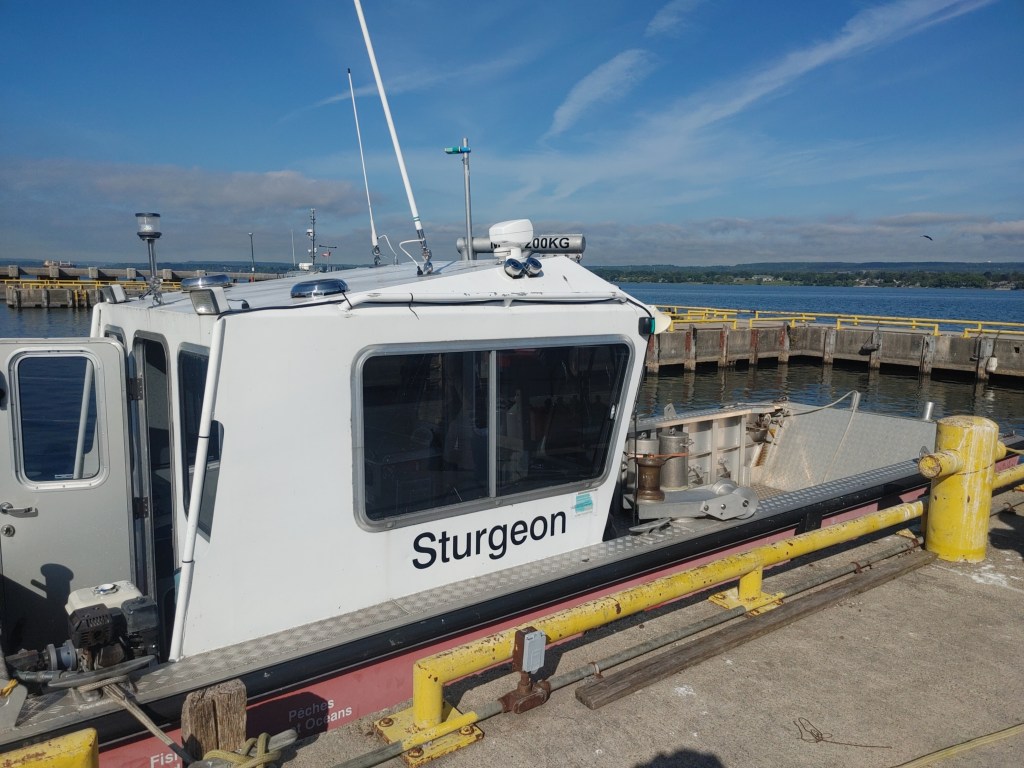
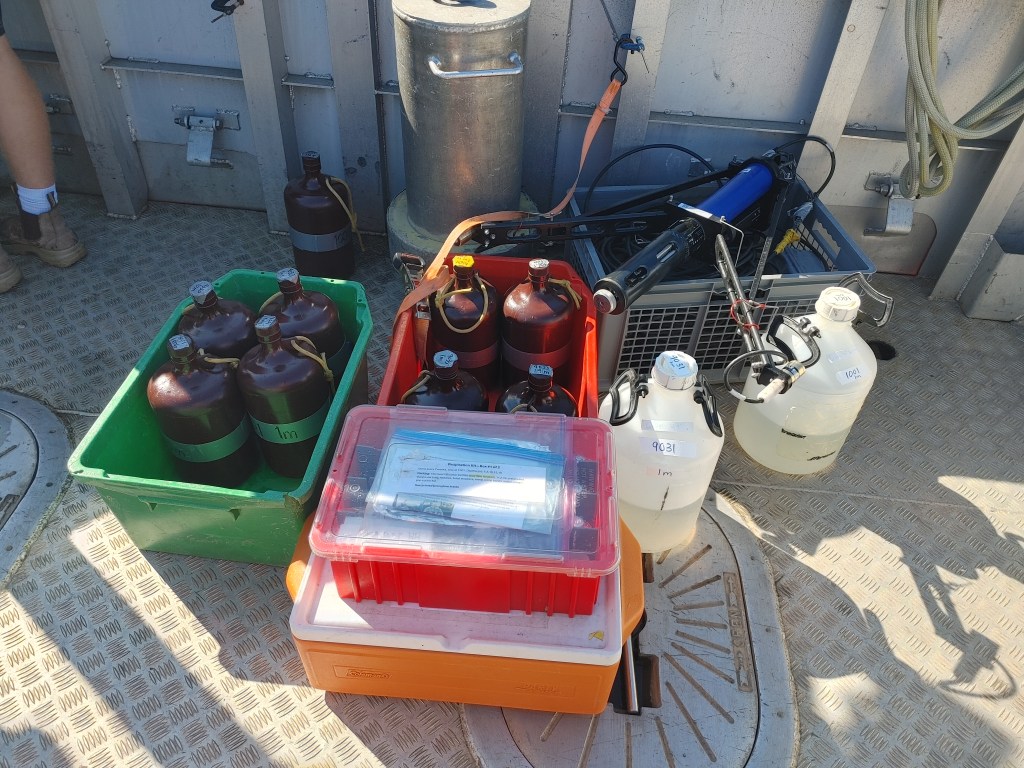
The main part of my job has become dealing with all of the Hamilton Harbour weekly sampling. Every week, one or two of us from the lab go out on the boat with staff from technical operations to collect lake water samples from 4 different sites around the Harbour, from a variety of depths. The main stuff we look for during the analysis part of things is the dissolved oxygen content at different depths; 1m, 5m, 10m, 15m, 19m, and how that content changes over the season. Currently, with the cold weather, the thermocline is non-existent so generally all the water collected from those depths has about the same dissolved oxygen content whereas earlier when the thermocline was much closer to the surface, there’d be a much more sever decline in DO content from depths like 5m to 10m.
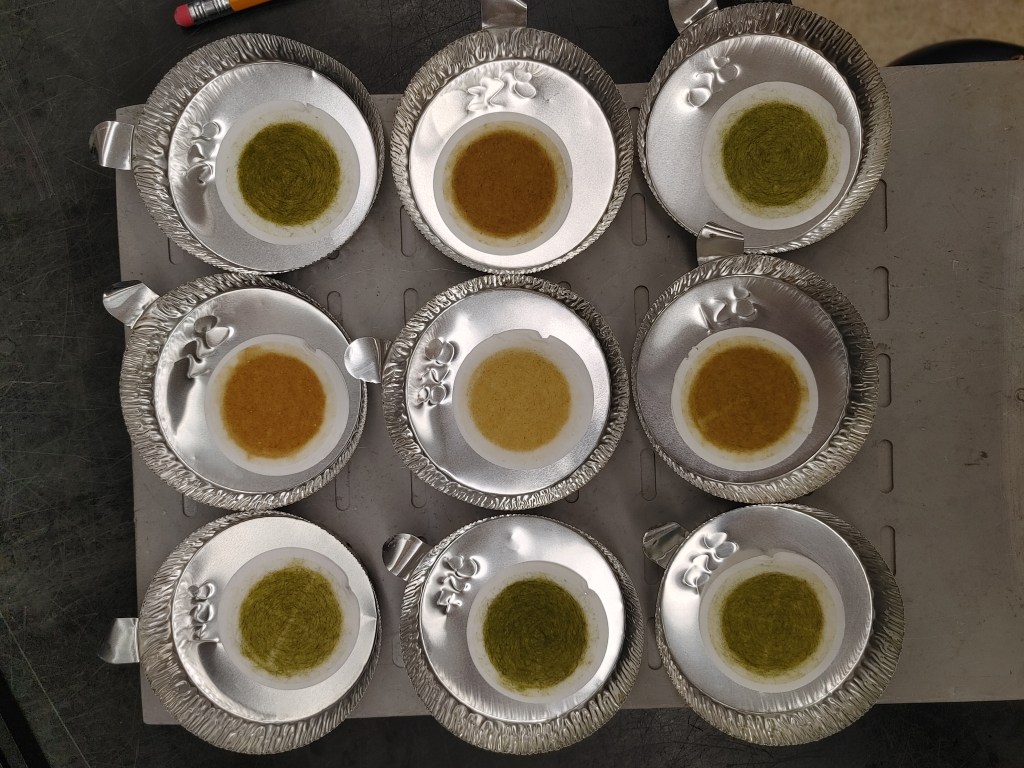
Other water samples we collect will be filtered with a variety of cellulose acetate and glass microfibre filters to eventually be analyzed for the presence of organic and inorganic carbon and nitrogen, ammonia, chlorophyll, and particulate matter. Generally, the days we go out on the Harbour and filter are the most interesting because it actually gives me a day worth of work to focus on. We have about one or two more weeks left on the Harbour so I am not too sure what I will be doing afterwards.
The Tank
Honestly, this work wasn’t even for our lab, but it was still a fun inclusion – an honourary mention if you will.
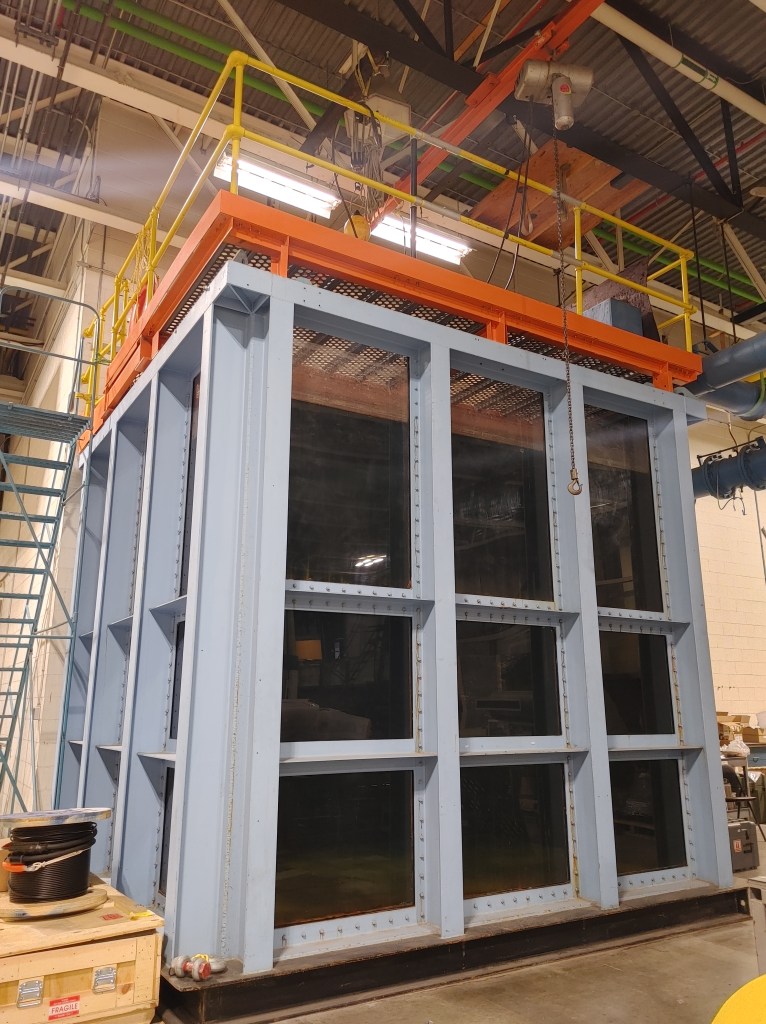
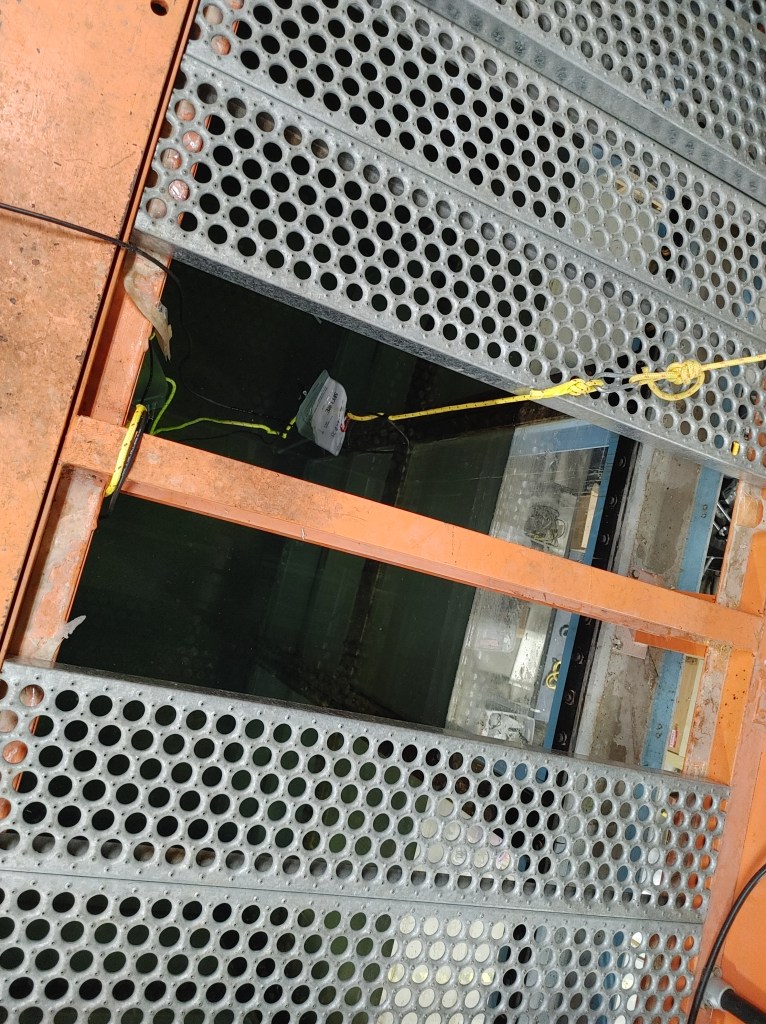
In the basement of the CCIW is the Hydraulics Lab. It boasts a few large wave tables, including one that looks like an Olympic swimming pool, and a large diving tank used to train their DFO and Technical Operations diving teams. I helped out another lab to put together their pump lines for sampling in Lake Ontario and it involved stringing large lengths of ropes and cables down into the diving tank to test to see if the pumps attached to IV bags were operational. It’s kind of scary kneeling over an open grate into a deep, dark diving tank knowing the water hadn’t been changed in however many years, but it was fun nonetheless to hang out in the forgotten corner of the CCIW pretending I was a deck hand slinging rope out from the depths.

Phosphorous Measurements and Bioreactors
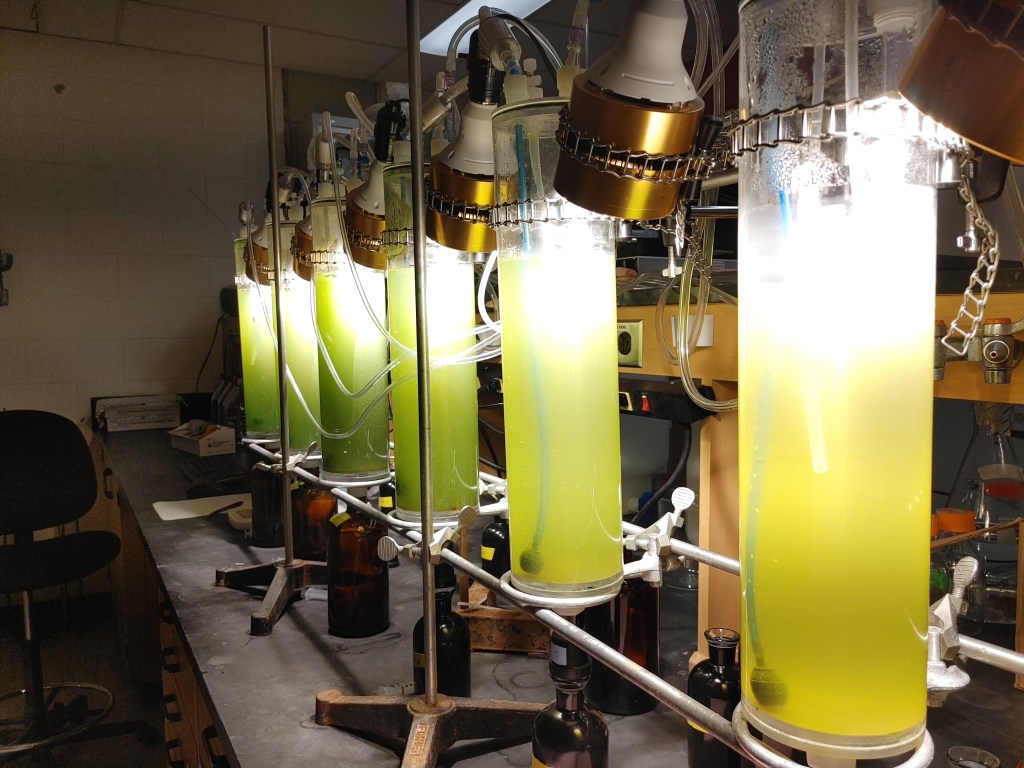
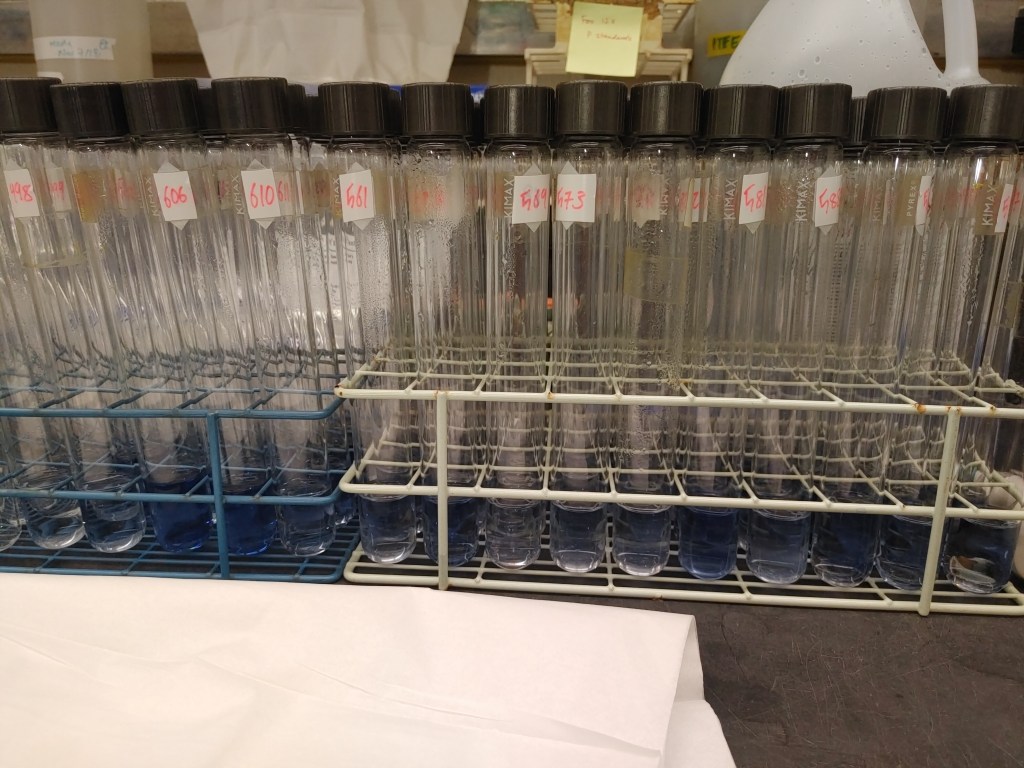
Our team is an amalgamation between two labs. While I officially work for Dave, him and his colleague Andy often share staff and resources so there has been a few times where I have helped out Andy’s lab with measuring the phosphorous content of hundreds of samples of algae. There’s nothing much to say other than it definitely looks cooler than it actually is and is pretty mundane in practice. After you’ve processed over a hundred test tubes of varying dilutions of algae in a reagent, then scrubbed and rinsed those hundred of test tubes, it loses its charm.
The LIMNOS
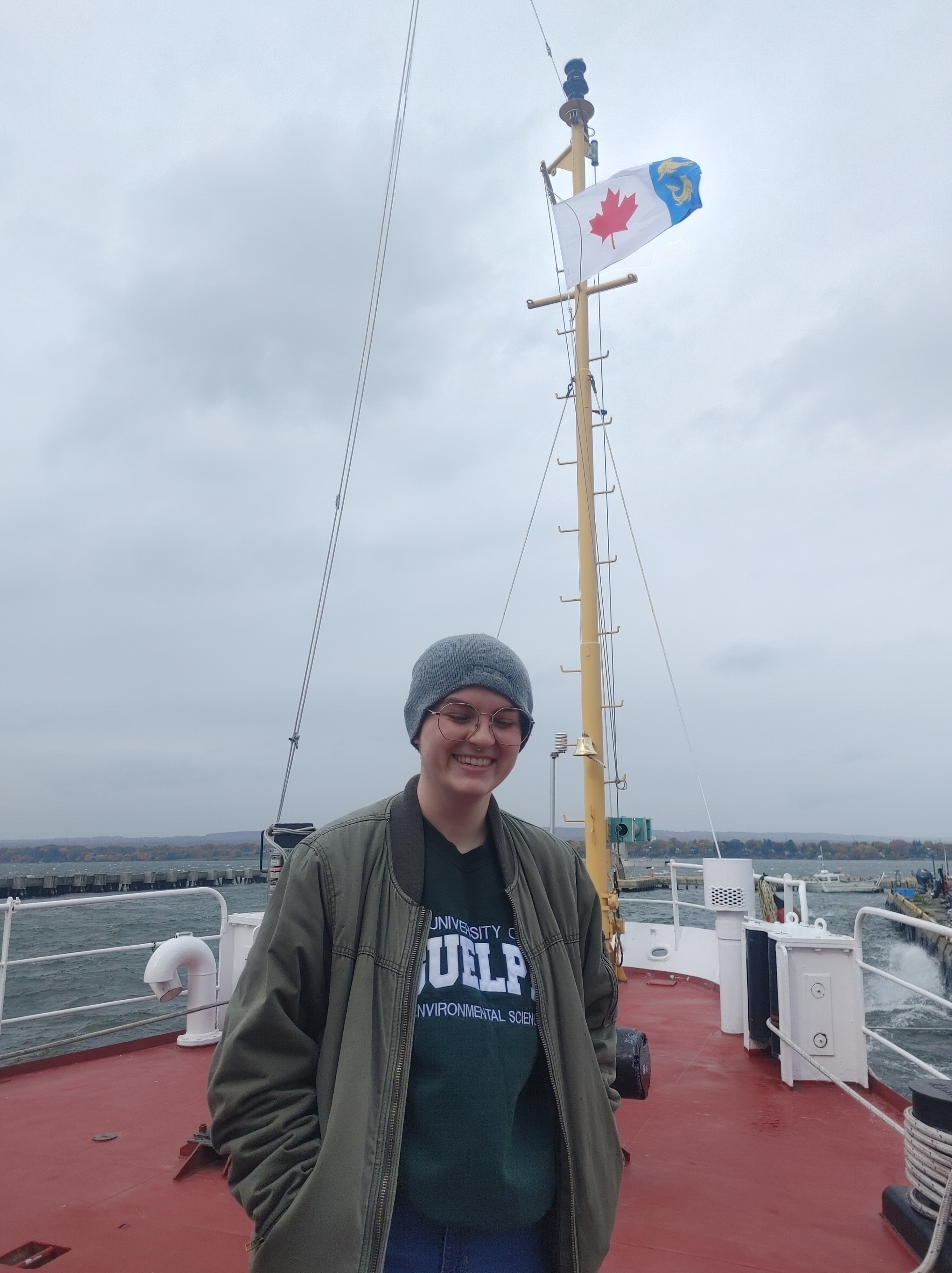
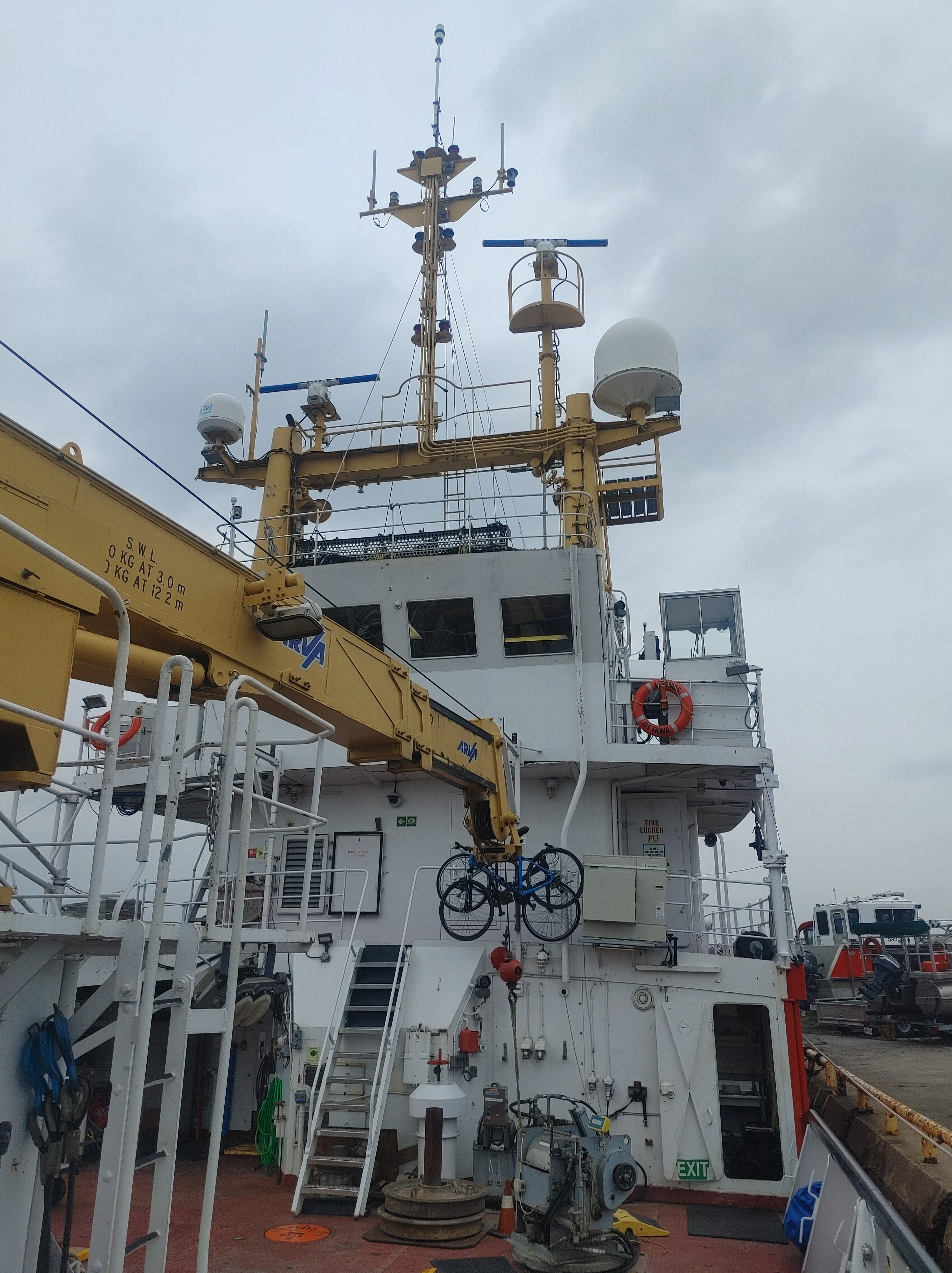
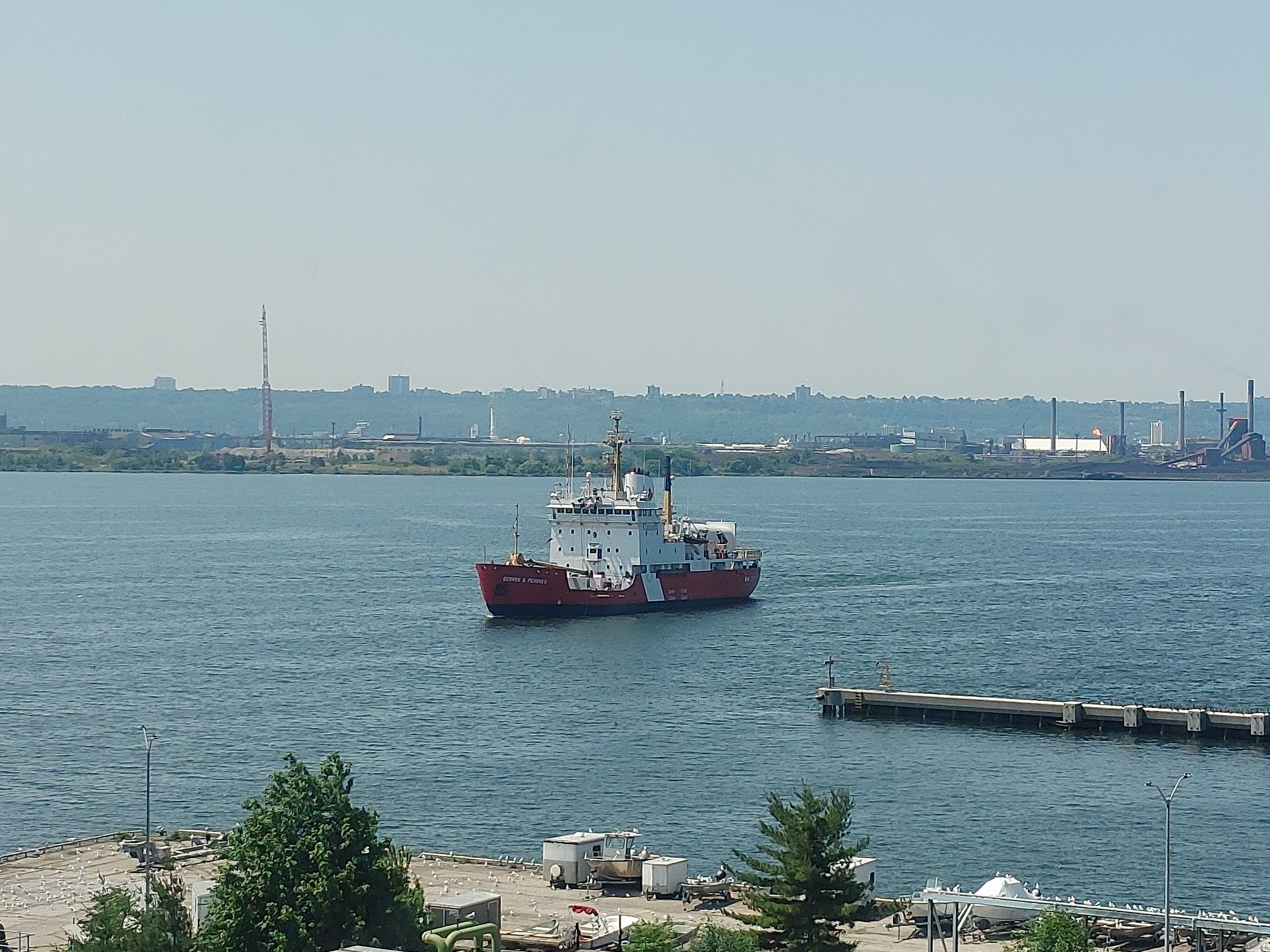
Today, we went out in the blistery weather to ask for a tour of the CCGS LIMNOS currently docked due to the bad weather. It was one of the few things on my bucket list to do at the CCIW before I left as I love to take tours of any boats I see on my travels and the concept of a floating lab was pretty interesting.
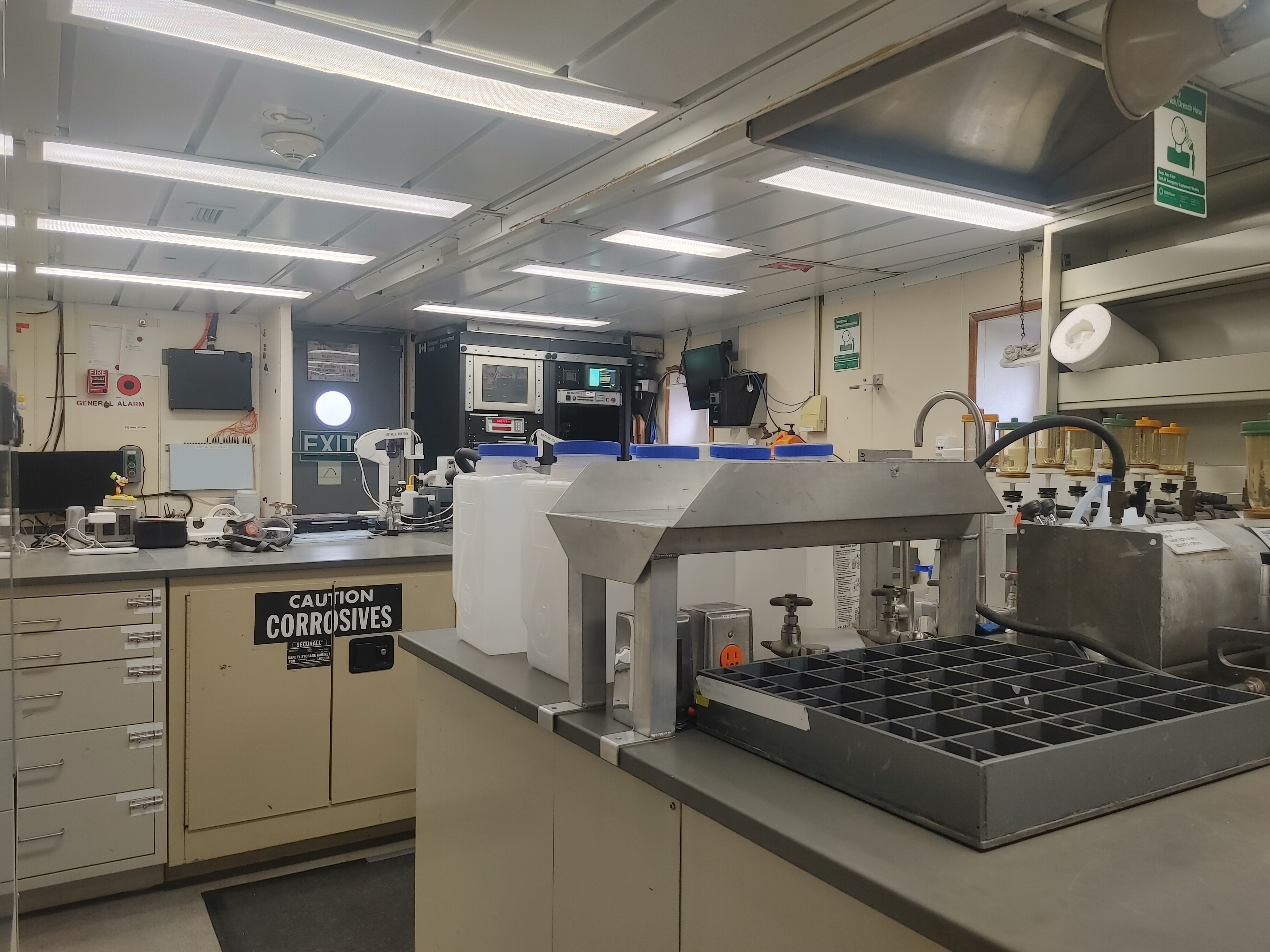
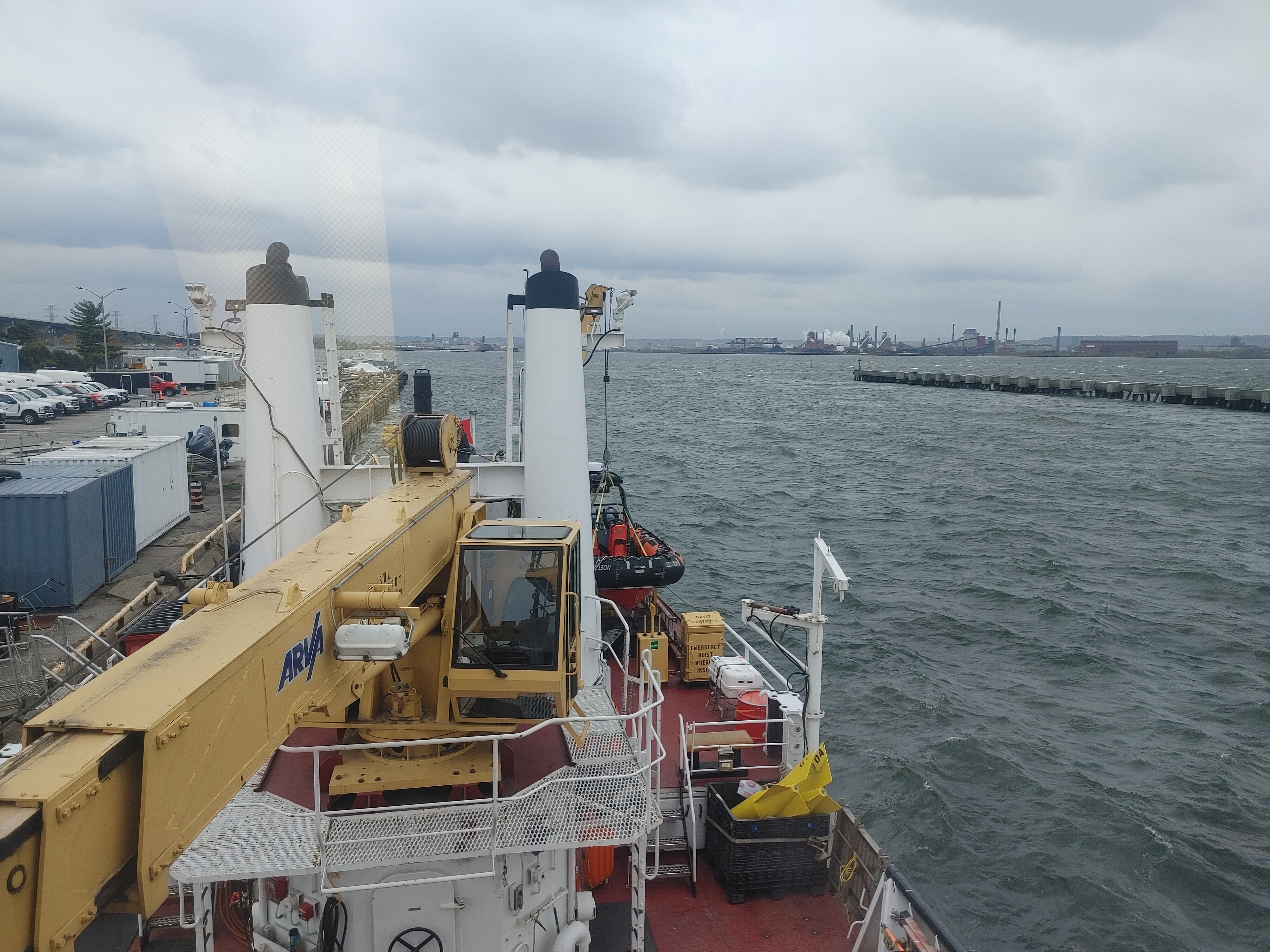
The vessel is named after the Greek island of Limnos – ‘limni’ being the Greek word for lake. She has been in service since 1968, and while experiences her fair share of issues, is still active and does her best to continue to serve the scientific research going on in the Great Lakes. Outfitted with all sorts of winches, cranes, drop-down platforms, smaller cruising vessels, and not one but two labs, she really has it all.
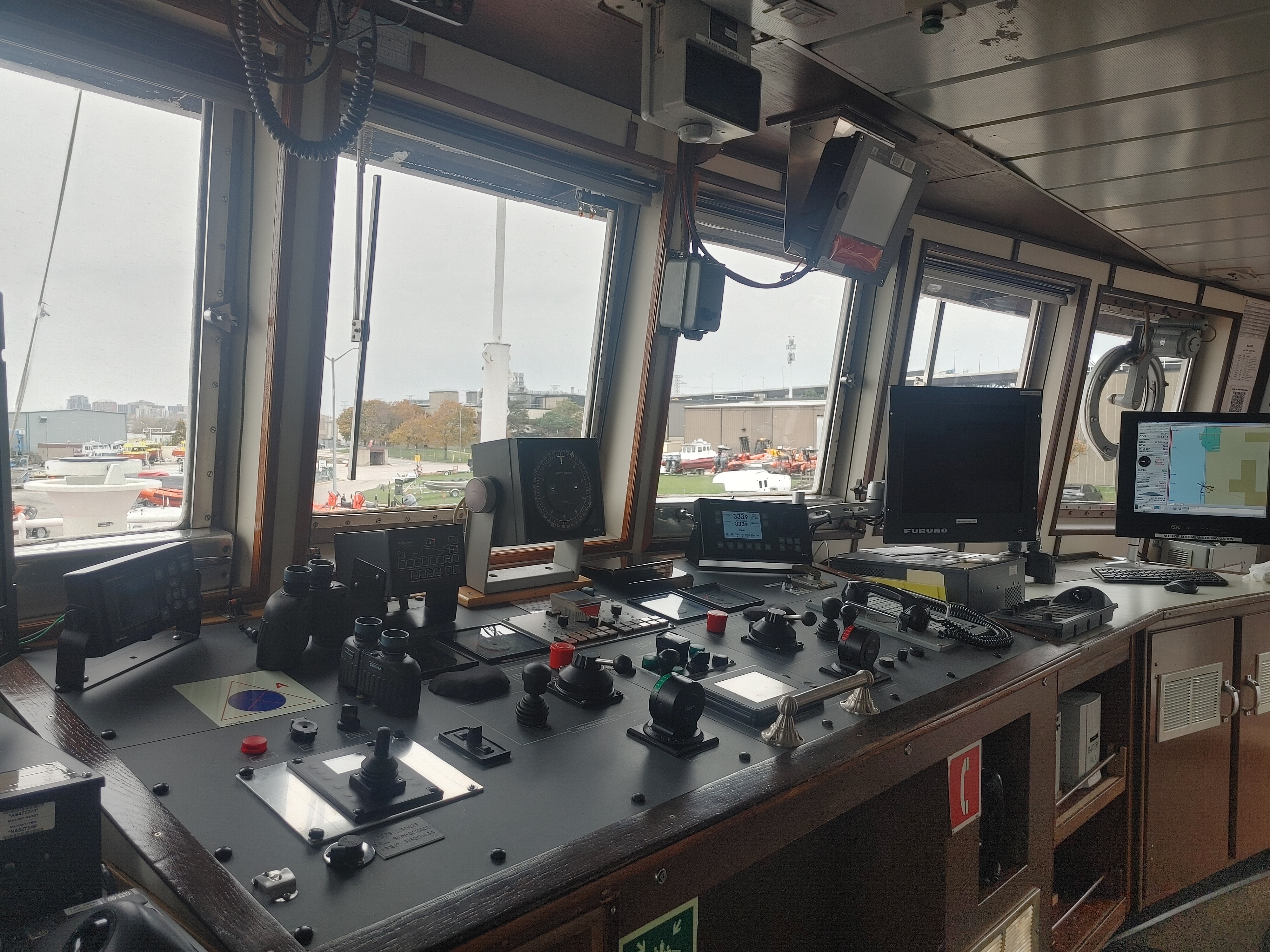
I didn’t take too many photos of the inside due to the fact there were crew milling around and trying to enjoy their time off due to the bad weather keeping them at port, but the inside is what you’d expect from a ship. Claustrophobic corridors, clever interior design to accommodate any direction of rocking, questionable shower and toilet placement, and steep stairways that any person over the average height may start to feel a little unsafe travelling. There were a few fun additions such as the stationary bike and weight pile inside the dry lab where if not in use, crew can work out. Apparently bigger vessels have their own actual gyms and not a co-working space. There are also mountain bikes mounted to the second story railing for days spent at port where crew may want to feel motion other than the waves, and a BBQ strapped to the base of the boat launch crane. We were led through the twisting hallways, taking as wide a stance as possible to keep our legs sturdy from the lull, and the crew member showed us everything from the crew and research crew berths, kitchen, mess halls, the bridge, engine room from afar, and finally, the bow.
Water sprayed up over the hull as the waves were growing more violent and the wind more forceful. I like to think I have pretty good sea legs (lake legs?), but even I was struggling to maintain my balance as my coworker tried to take a photo of me. If the wind wasn’t pushing you over, the next wave crashing into the side certainly was. We concluded the tour once it began to spit rain, and the conversation about crew breakfast was cut prematurely.
Vessel Safety Training
In order to work on any of the research vessels, or really any boat in any capacity, it is required I get my Small Domestic Vessel Basic Safety [SDV-BS] certification. It was a day long online class with a company out in BC so while I didn’t have to get up any earlier than 10am, I was logged on until 7pm listening to a guy who was currently working on a boat tell me all the horrible ways things can go wrong. I am, of course, being overdramatic. This certification is good for life, and an awesome asset to have as I look into more boat-related work.
In a weird way, I have to thank the budget cuts for holding getting on the boat over my head because it has encouraged me to apply for the DFO Fisheries Student and In-Shore Boat Rescue Student with the Canadian Coast Guard positions for next summer as I don’t think I got my fill of boat stuff at all. I am just about to get my Maritime Restricted Operator VHF Radio certification, so I am ready to hit the ground (water?) running with the DFO and CCG if it all works out.
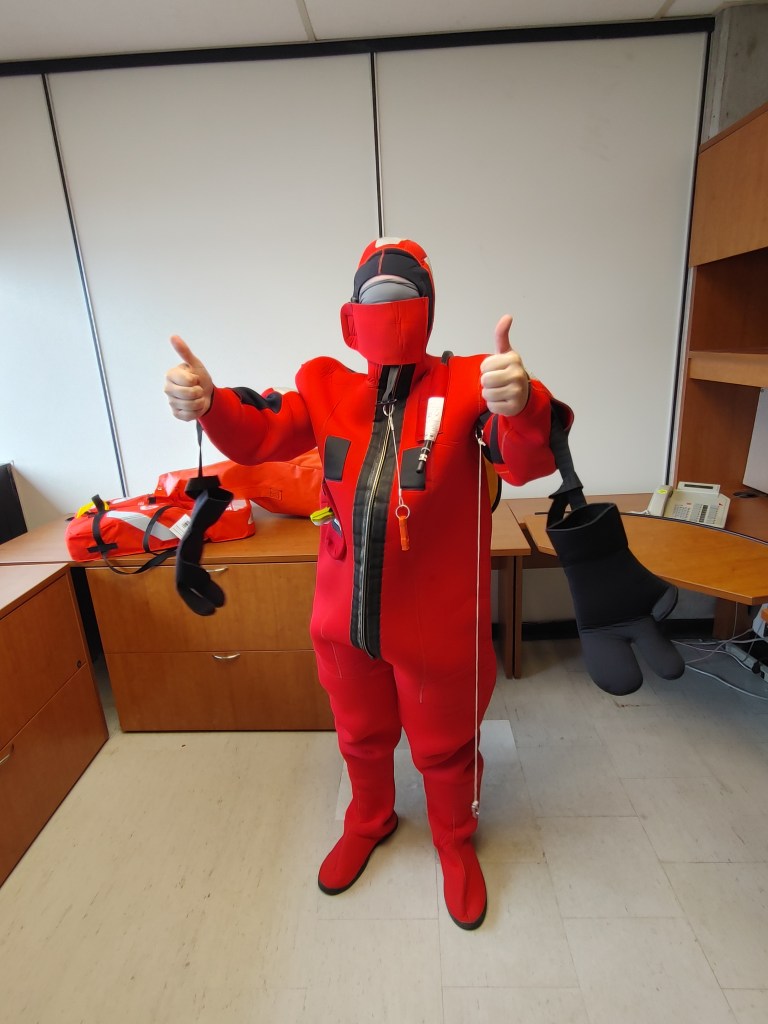
Anyway, here are some funny photos of me wearing the immersion suit that we have to show we know how to put on blindfolded in under a minute. They may be one size fits all, but that doesn’t mean it fits nicely.
All in all, I am very happy I took this job despite it all. It was fun to stay local for once, even if I missed diving headfirst into something completely new. I suppose I got my fill with my brief trip out to the east coast in the week after exams but before the start of co-op, and I tried my best to visit the cottage when it worked out.
I spent another lovely season with The Limes and got to make plenty of new ball hockey buds playing on The Muskies for the summer Cambridge league, as well as enjoyed staying local to keep playing in the epic Rime of the Frostmaiden D&D campaign I am a part of. Despite keeping motivation for work being one of my biggest obstacles, I was at least able to spend more time doing what I loved outside of work like seeing friends, going to fun events that I otherwise would have missed, and exploring myself as I continue to change as an individual. I don’t expect anyone to really understand that last part, it’s certainly a nod to whatever future me reads this back so I can remember.
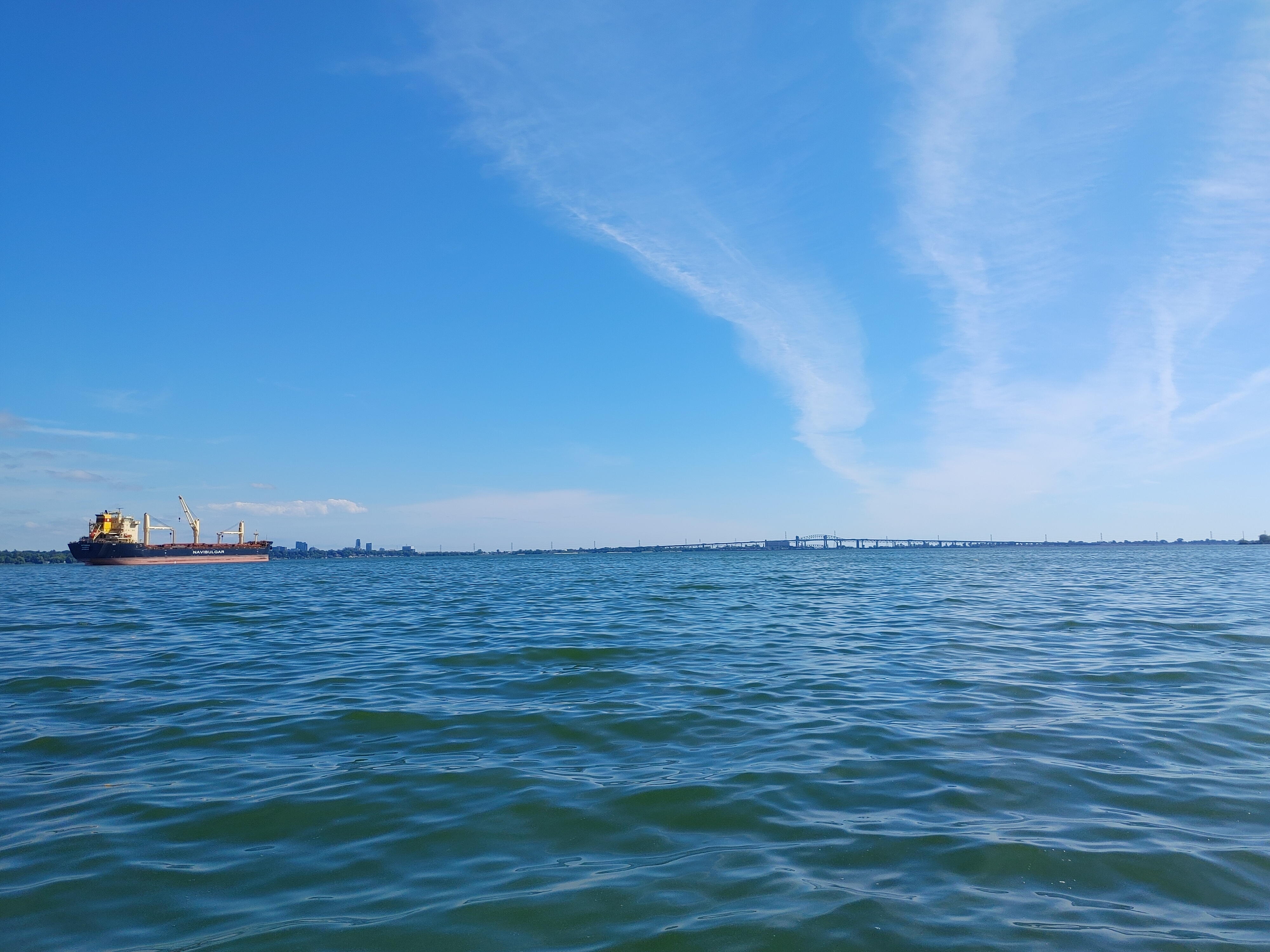
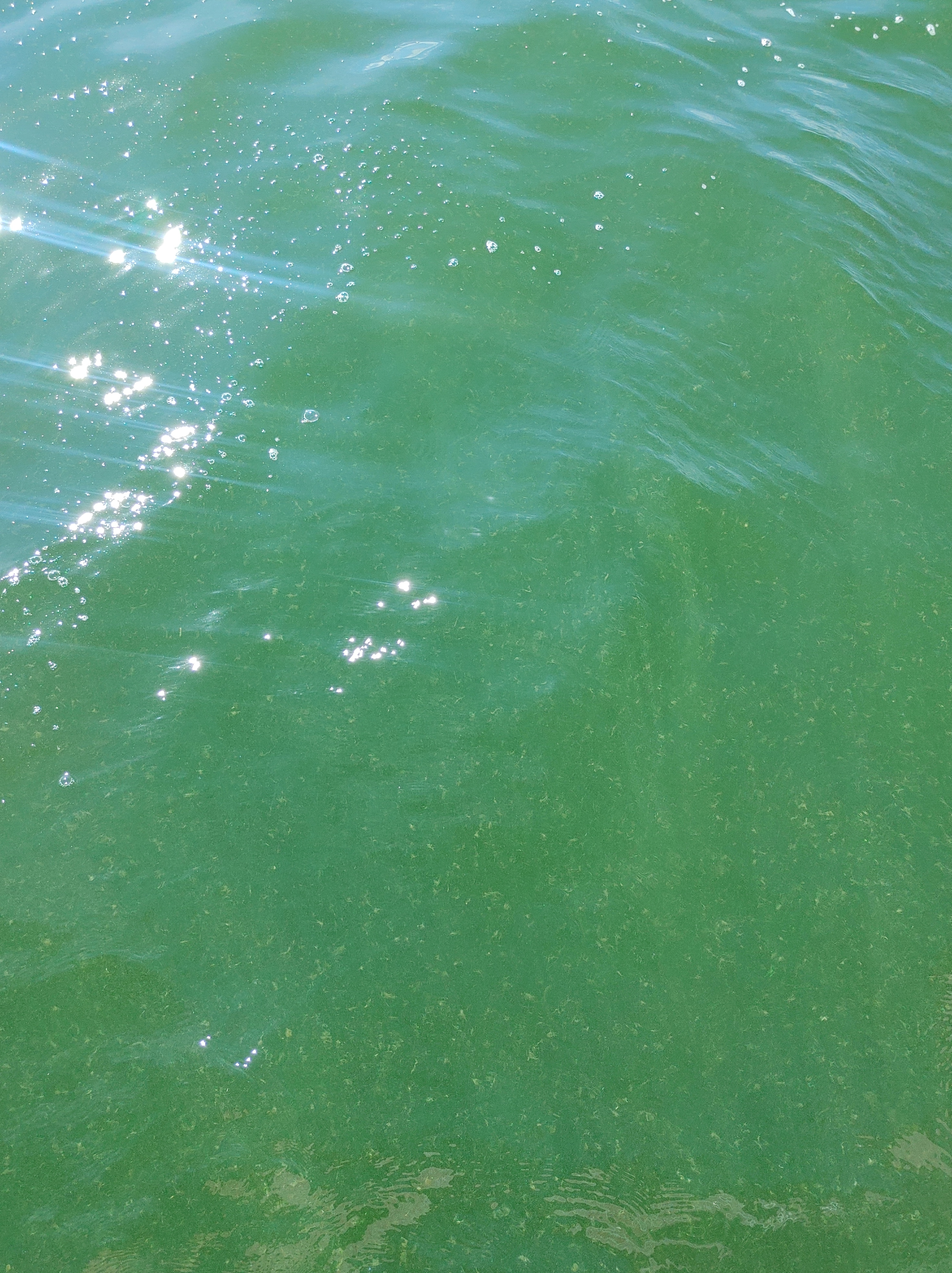
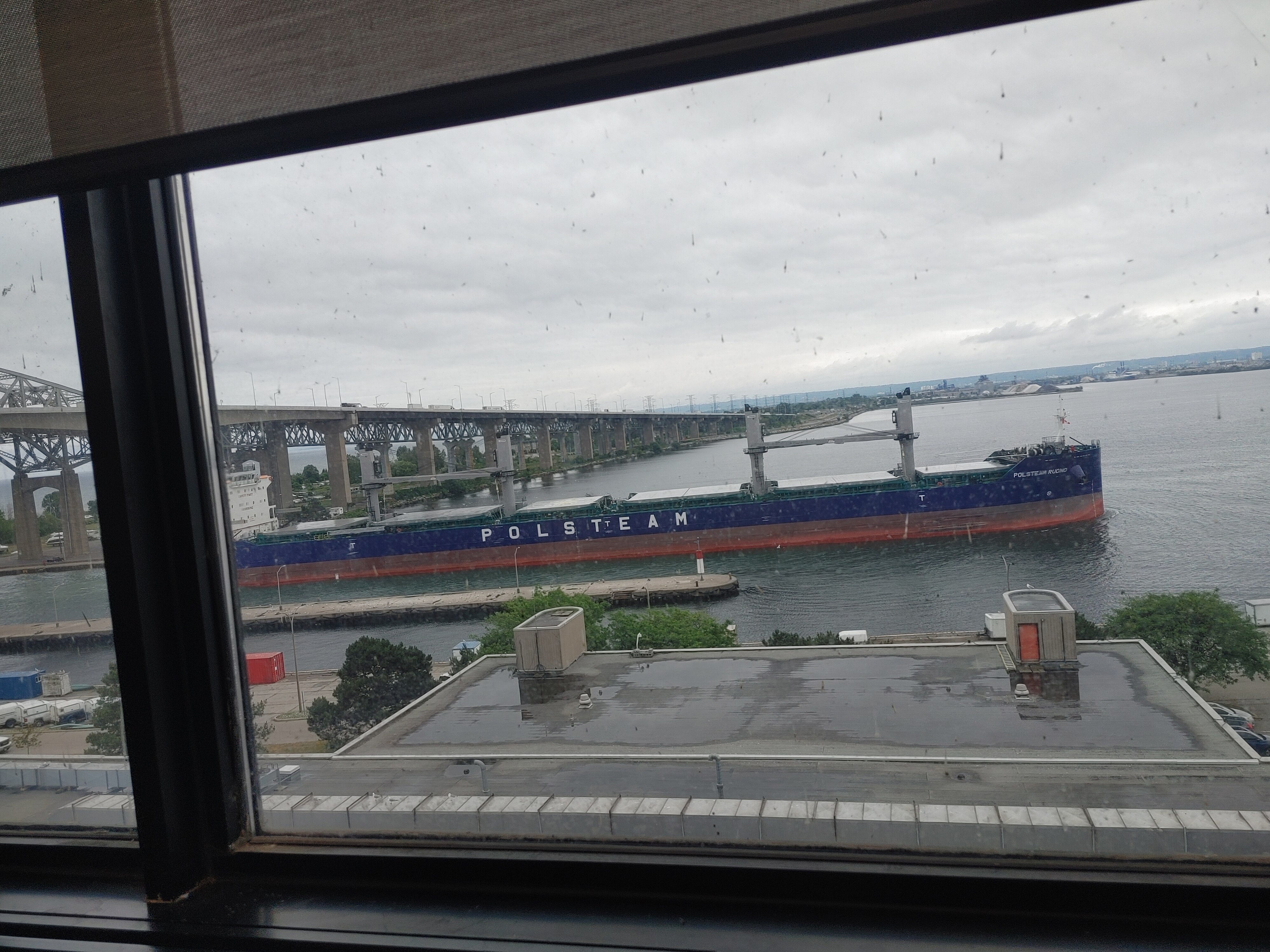
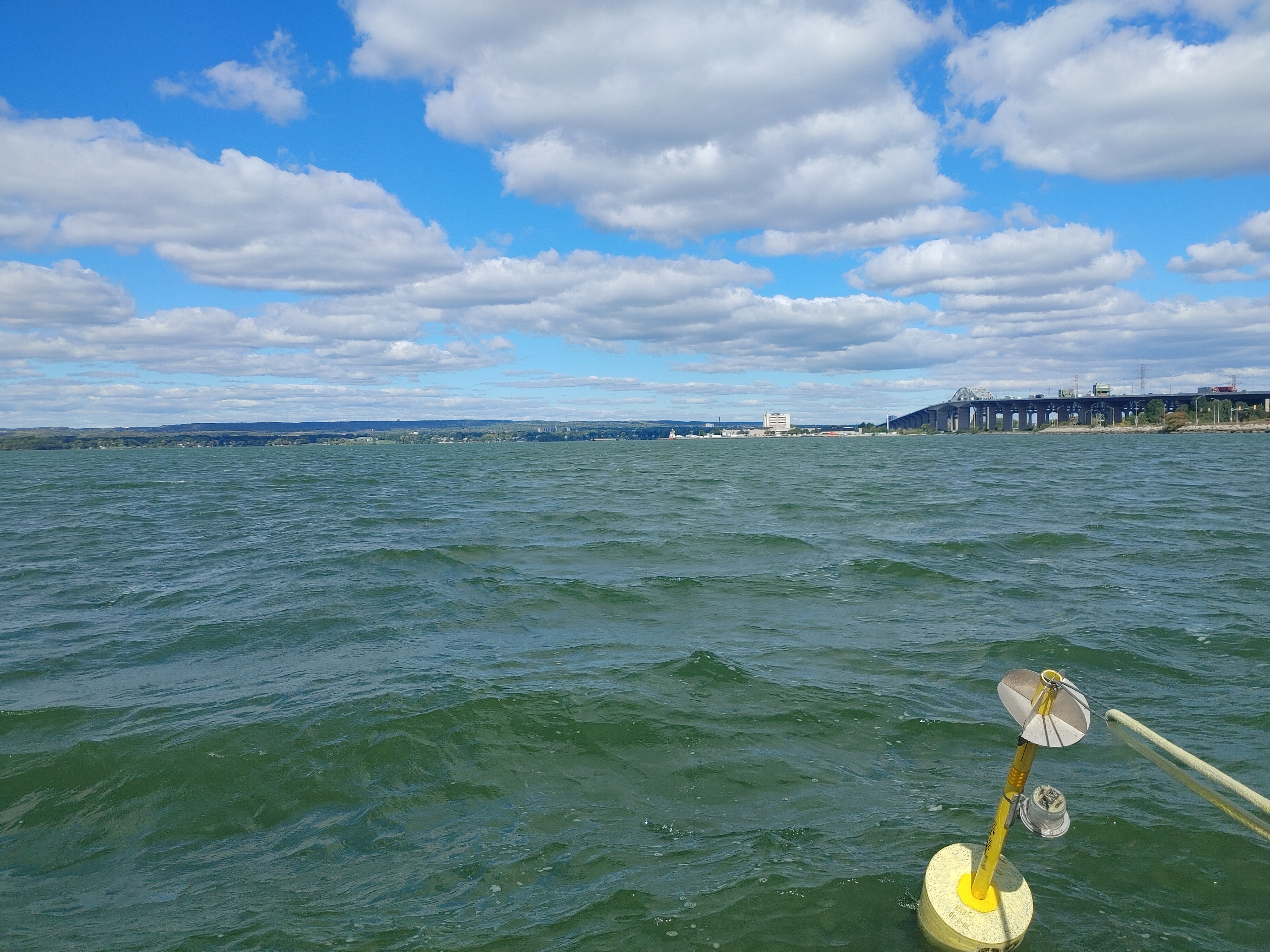
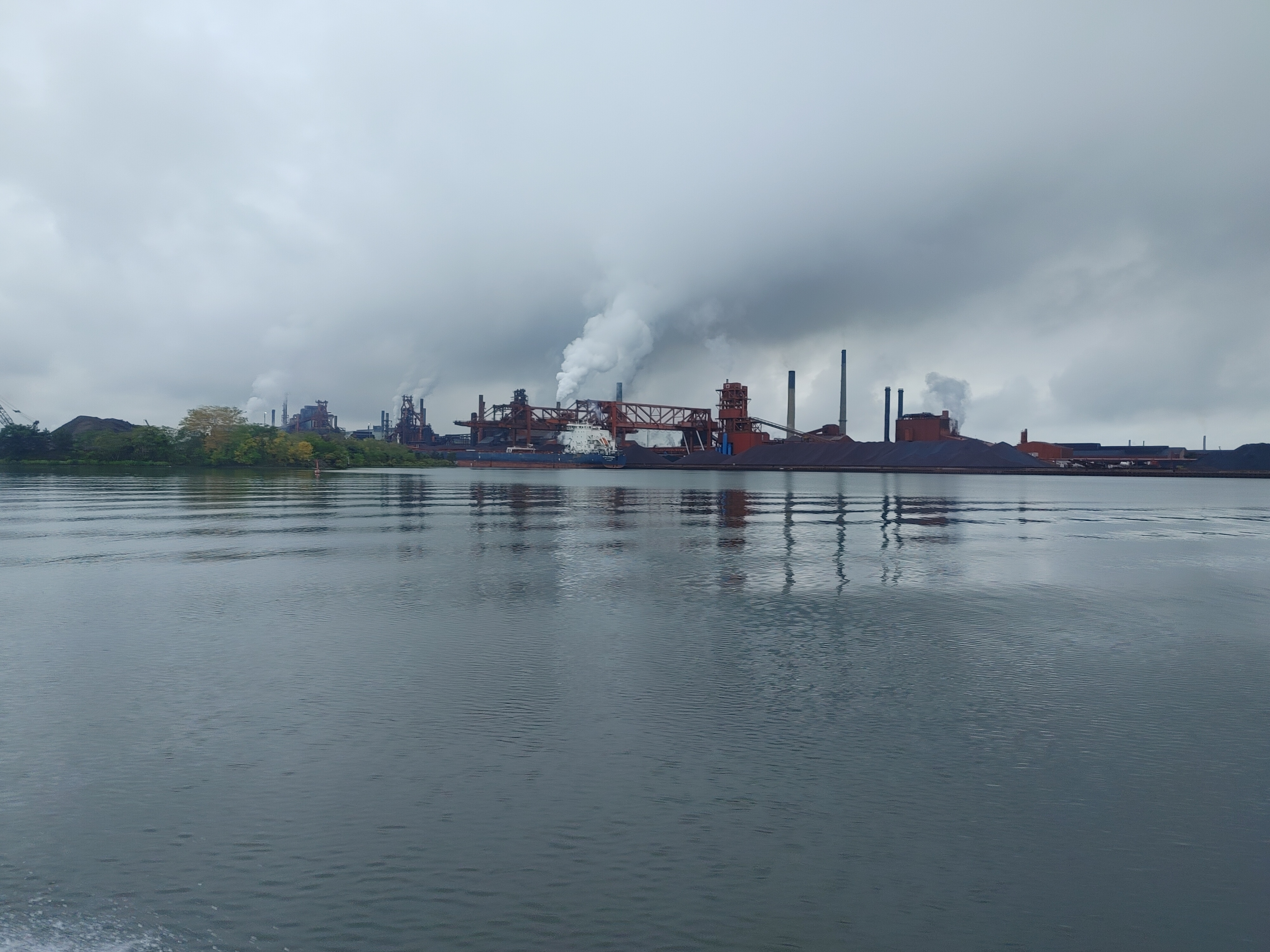
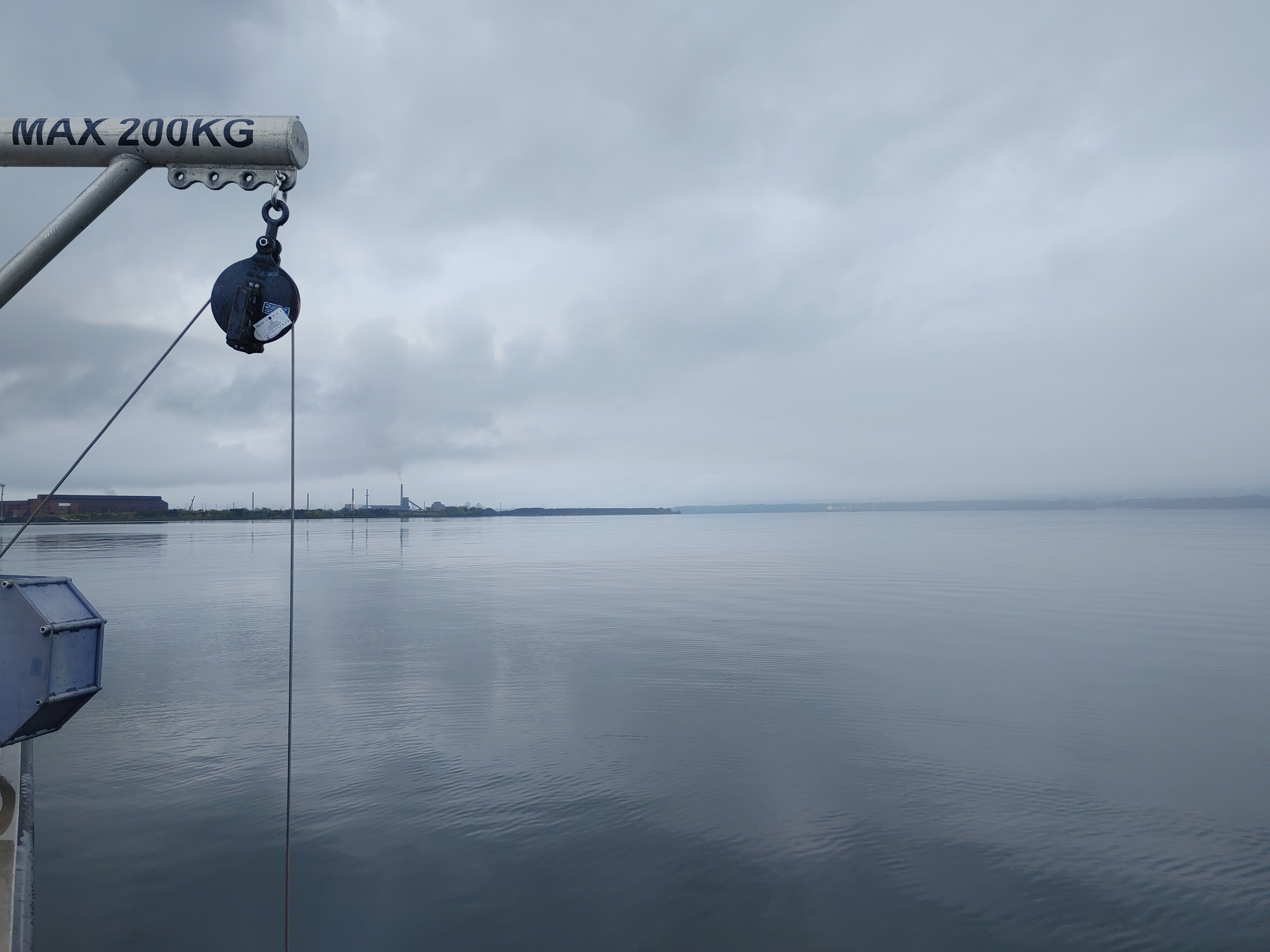
Here is a collection of photos I took over the months of the beauty of Hamilton Harbour. While I definitely recommend enjoying the view, after all the water I filtered, I can’t recommend going for a swim. It’s kind of nasty.

 Alert-120
Leave a comment