Polar night is when the night lasts for over 24 hours in the northernmost and southernmost regions of Earth. There are a few different types of ‘polar nights’ and all of them correspond to an increasing level of darkness as the sun lowers further below the horizon the higher north (or lower south) you travel.
-Polar Twilight: Areas that are located just within the borders of polar circles (e.g., Arctic Circle, Antarctic Circle), where the sun will be on the cusp of the horizon on the winter solstice. It may not look like traditional night, and there may be enough light refracted by the sun below the horizon that you do not need lights to navigate outdoors. Despite the light still provided by the sun, this is still considered polar night.
-Civil Polar Night: There are only a few locations on Earth that experience Civil Polar Night, and Pond Inlet, NU only experiences this for roughly 10 days at the end of December. While very dark, civil polar night is when there is a faint glow of light on the horizon visible at midday.
-Nautical Polar Night: Absolutely no trace of daylight, except for the possibility of faint glow at midday due to how light refracts in the atmosphere. I can’t really explain how this differs from Civil Polar Night besides the sun being at different degrees below the horizon. Alert experiences this from November 19th to January 22nd.
-Astronomical Polar Night: Continuous night with absolutely no twilight/daylight unlike faint glows in previous classifications of polar night. This is pretty much the kind of astronomical level of darkness you’d get being as close to either pole as possible. Even the dimmest stars visible to the naked eye can be seen all day. The only humans to experience astronomical polar night are hanging out in the Amundsen-Scott South Pole Station where their winter lasts from February to October and they are completely isolated for that time (so this is where The Thing could realistically occur).
When the ‘Midnight Sun’ makes its appearance, I can talk about the opposite of these phenomena as I think it’s incredibly cool. I encourage anyone to google polar night and see pictures of the different variations all around the world from Svalbard, Antarctica, Nunavut, and either of the poles.
***
The past two weeks the weather has been extremely favourable. -35 with no wind, barely any snow, and a sky full of stars. The stars stretch from horizon to horizon and twinkle from above. There are a few extremely bright stars that I do not have a name for as believe it or not, my constellation app doesn’t have data for this far up.
Satellites will lazily float across the sky above, and if you’re lucky, you can catch the flash of a shooting star from the corner of your eye. From the metal tower I like to look up and take it in and think my thoughts. Unfortunately, and maybe ironically, I am too far north to see the Northern Lights but that just means I’ll be more excited to see them when I eventually get the chance further south. I’ve been toying with a trip to Churchill Manitoba next year for winter break and travel there by train, though I’d have to start booking accommodations NOW as February is peak tourism time for the Northern Lights.
This Wednesday, while driving to the lab, we noticed a strange glow from beyond Dean Hill (colloquially known as Crystal Mountain) and Mount Pullen. It was ever so faintly blue in hue and was bright enough to just barely outline the small mountains that line the horizon. For a moment I thought I was seeing things before getting Hannah to stop.
From behind the lab, it was even more apparent.
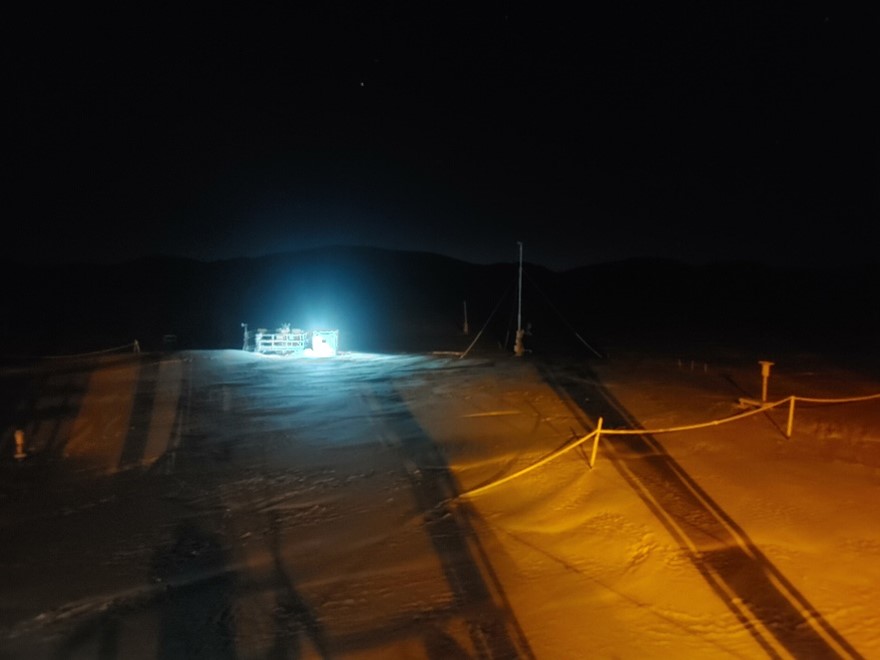
^ From the old lab wooden platform. The long exposure plus the light from the building and platform make it look brighter than it actually was.

^ More realistic to what it looked like in person, however, you can see the ground in front of me in the photo. I could not see the ground in front of me in real life.
Later that day, I would get my answer on what I was seeing. This was before I did all the googling on what different types of polar night there were.
It was the sun! Or well, the ends of light rays refracting through the atmosphere to fainty glow behind the mountains. As we are passed the equinox, the days will begin to get longer and the sun will ever so slightly reach towards the horizon until on February 28th on the polar sunrise, briefly say hello before dipping back below.
Knowing it is the sun behind those mountains makes me feel a little less scared to be outside and I can only imagine how nice it must feel to some of the people who have been on station since the sun last set in October to finally see the signs of its return.
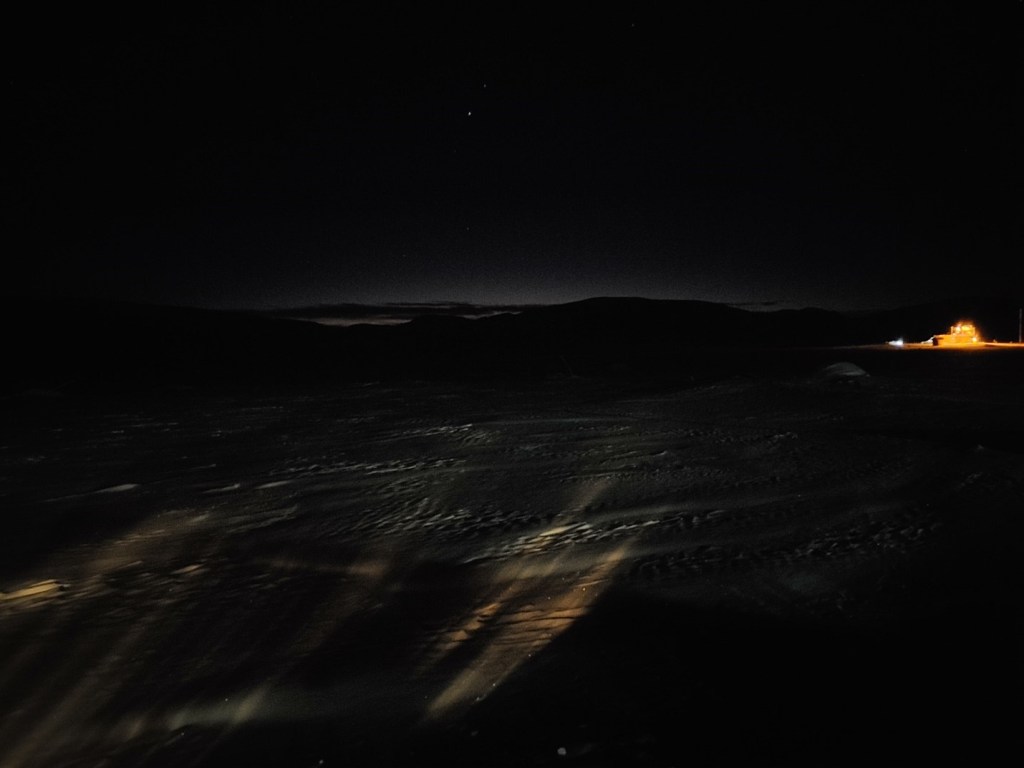
^Another picture from farther away. To the right is the lab, and the light on the snow is from the truck. While driving back to the lab, I couldn’t keep my eyes off it.
Here are some photos that I wanted to share but don’t necessarily have anything too important to say about. It’s a smaller entry today as things start to feel less new and more mundane, though I was thinking about talking about a polar phenomenon or something related to being up here to expand my own knowledge but also share it with everyone back home.

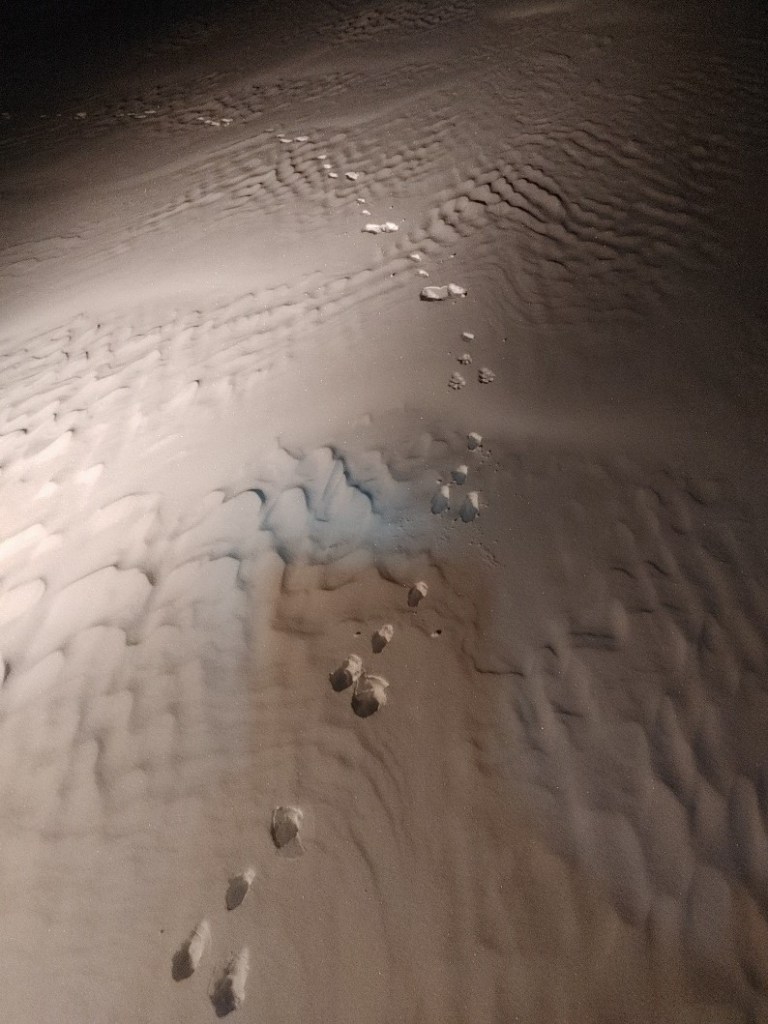
^These are Arctic Hare prints. The two front paws will stay in line with each-other with the two back feet lagging slightly in front of the other. Apparently, they have been known to eat fox carcasses so I should watch my back.
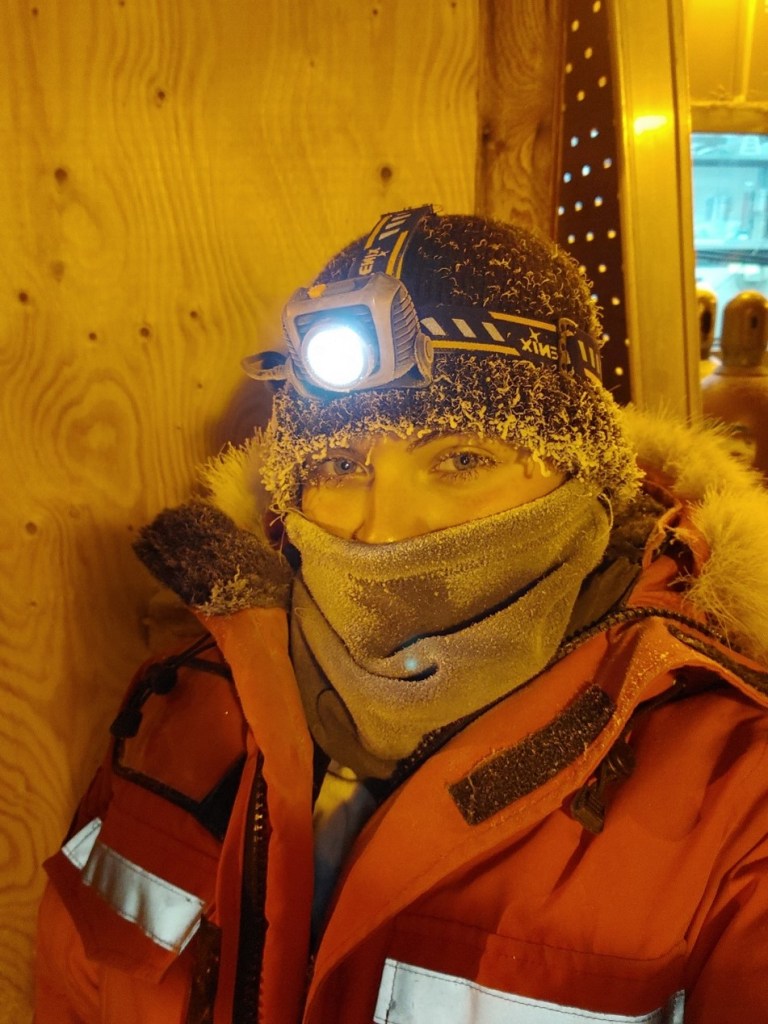
^ My favourite and least expected thing so far about working outside is your eyelashes will frost over. Sometimes if they were already wet when going out, and you close your eyes for too long, you won’t be able to open them (tested by yours truly)


 Alert-120
Leave a comment