I was wondering when we would get our first polar bear on station. I was actually feeling a little disappointed there would be a chance one wouldn’t be seen until after I had left in April as the sea ice begins to melt. You can imagine my surprise when it was announced over the PA this Monday that a polar bear had been spotted on the ice by the airfield on Monday (Feb. 26).
“Attention all station personnel…there has been —— on the airfield ——. The station is now in ——- condition 1. I repeat,” the SWO was barely audible over the PA in the dining hall that morning. Everyone in the line for fresh eggs looked a little confused, double taking at the windows and the very nice weather conditions. Well, if the announcement wasn’t for a storm condition, there’s no other condition than bear condition. The possibility of a bear was all anybody talked about for all of breakfast.
There are three levels of storm condition, I’ve only experienced condition 1 which was the windstorm we experienced earlier this month, but only 2 conditions for polar bears.
- Polar Bear Condition 1 – Polar Bear and/or Polar Bear tracks have been spotted 6-10km of the station. All personnel are to stay within the station if possible, and if leaving the station is necessary (mostly for work purposes), all personnel are to utilize the buddy system.
- Polar Bear Condition 2 – Polar Bear is seen ON station. No one is to leave the station, and if in a building away from the main station, you are to stay put. There needs to be strict permission given by the Senior Warrant Officer (SWO) to go outside, and you must be in pairs.
You can also imagine my surprise when said polar bear, later we would find out – polar BEARS with an S, would be seen on station walking down water street towards the pump house. South. Towards the GAW Lab, where me and Hannah were for the day.
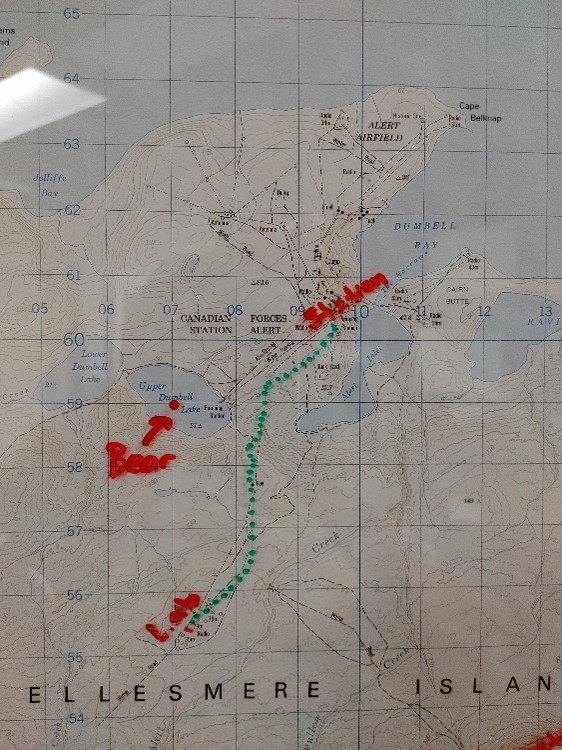
^We would later find out that the SWO gave the wrong lake name and announced over the radio that the bear was in the middle of Upper Dumbbell Lake (as pictured), however, I would later find out it was actually over in the Alert Inlet, parallel to the station. So, while our worries were valid, we did not have to stress out as much as we did assuming the bear was only a few kilometers away.
I didn’t actually get to see either of the bears, but one of my friend who works hydro was helping keep track of one of them. This is the larger of the two and believed to be the male. The other was smaller, who I would assume is probably a female that the male followed off the sea ice. Why they left the sea ice (which sprawls for several kilometers unbroken) in the first place is a mystery as usually polar bears don’t leave the ice until it breaks up enough in the summer, and they take to hunting on land.
Mating season takes place mostly between March and May, and males will follow females for days, and spend upwards of 2 weeks together though that does not stop females from mating with multiple males (and cubs can have multiple fathers in one litter). Otherwise, they’re mostly solitary besides mother bears and her cubs.
Polar bears are considered hypercarnivores. Like carnivores, but way more intense. Approximately, 70% more intense. Hypercarnivores are animals with diets that are 70% or more made up of meat, and polar bears happen to have nearly 100% meat and animal fat diets, making them the most carnivorous species of any bear and apex predator of the Arctic. Their top pick for a meal is seal as the blubber is what keeps their fat reserves strong for month-long stints without eating, though they are not above cannibalism if worse comes to worse. Their digestive systems are so specialized to break down meat, that even if there were plants in the area to eat reliably, it would do more harm than good in the long term.
I am currently reading the novel Ice Walker by James Raffan which follows the life of a 6-year-old female polar bear with many sprinklings of scientific observations about polar bears, as well as their interactions with humans and the ever-changing environment. It’s a fascinating read into the ecology of polar bears as well as how a polar bear lives their life in an increasingly smaller range with less reliable sources of food as the polar ice melts earlier in the season, and humans sprawl ever north.
People will say polar bears don’t actively hunt humans. I don’t entirely believe them. Any wild animal that is hungry enough doesn’t care about who or who isn’t human or a seal, meat is meat and when you’re a hypercarnivore, it’s all a numbers game of how much, when, and how often.
In our debrief to the station, when the topic of close encounters will polar bears came up, I will never forget what the Commanding Officer (CO) said, “What’s that saying? If it’s black, fight back, if it’s brown, lay down, if it’s white, goodnight? Yeah, I won’t sugar coat it, if you’re being attacked by one of these guys, you’re dead,” before mentioning that if you’re running from a polar bear, to strip off your layers and throw it behind you so it may buy you an extra few seconds to make it to safety. Emphasis on the word may.
Needless to say, don’t fuck around with polar bears.

 Alert-120
Leave a reply to Entry #33 – Move Your Paws for a Polar Bear Cause – Alert-120 Cancel reply